Nextdoor vs. Facebook Neighborhood Groups vs. Town Subreddits: Where HVAC Recommendations Actually Happen
The honest answer is 'it depends on your metro,' but it doesn't depend in the ways operators usually guess. Here's how to figure out which surface is primary in your service area.
The most common question we get from HVAC operators planning their neighborhood-surface strategy: "Should I focus on Nextdoor, Facebook groups, or local Reddit?"
The honest answer is "it depends on your metro" — but it doesn't depend in the ways operators usually guess. The variables that actually predict which surface dominates aren't audience size or platform age; they're demographic and demographic-adjacent factors that vary sharply between metros. This post is the rough mental model for figuring out which surface is primary in your specific market.
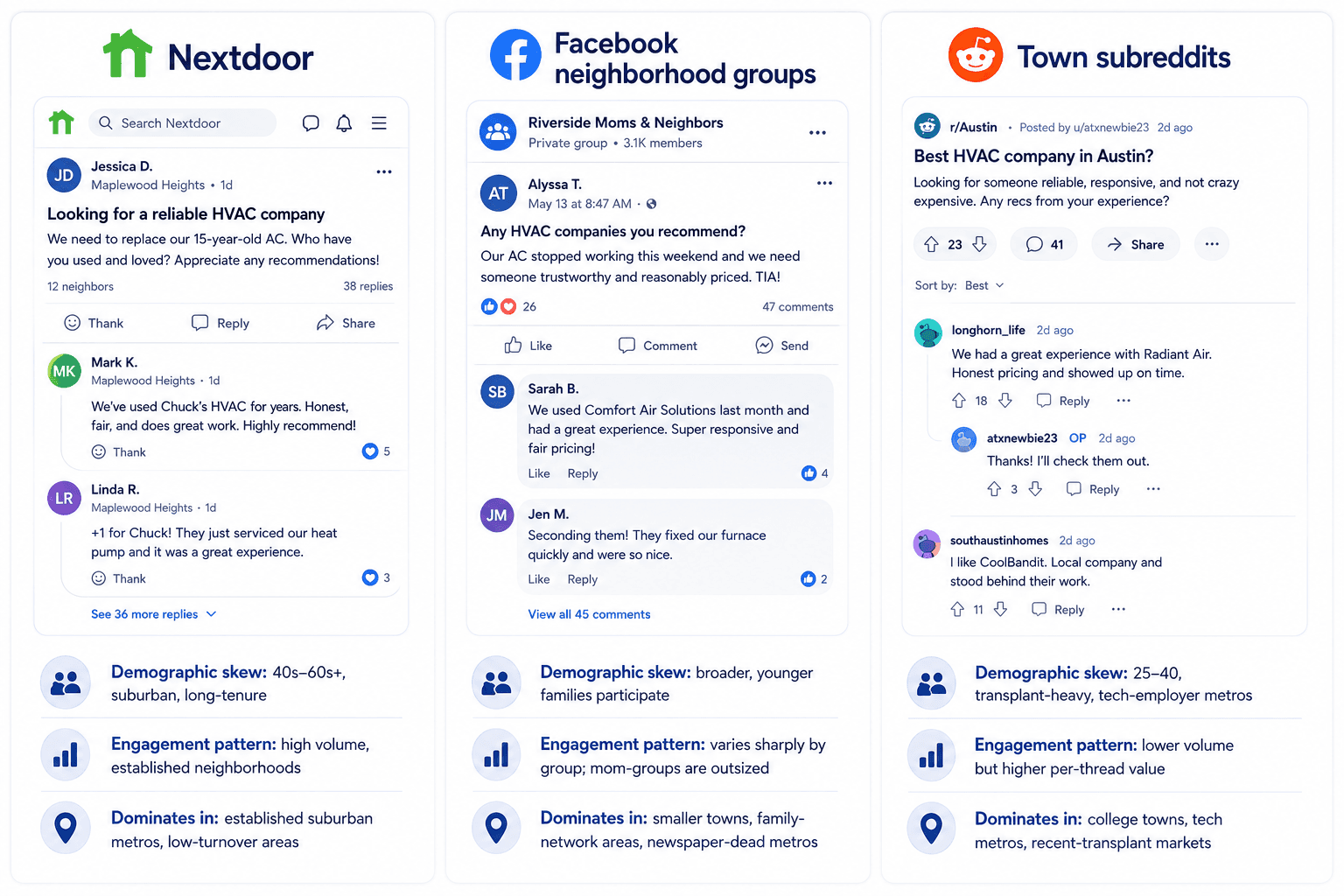
Nextdoor: where it dominates
Nextdoor's audience skews older (40s–60s+), more suburban, more homeowner, more long-tenure-in-the-neighborhood. That demographic happens to be the exact demographic that asks for HVAC recommendations frequently — they own homes, they have aging systems, they're risk-averse about contractors, and they default to asking their neighbors before searching online.
Nextdoor tends to be the primary recommendation surface in: established suburban metros, neighborhoods built before 1990, areas with relatively low population turnover, and metros with median household ages above ~45. The Northeast and parts of the Midwest skew heavily Nextdoor-dominant for HVAC threads.
It tends to be a secondary surface in: dense urban metros (where many residents are renters who don't ask about HVAC), new-build suburbs (where neighbors don't know each other yet and use Facebook groups instead), and college towns.
Facebook neighborhood groups: where they dominate
Local Facebook groups — usually named for a town, neighborhood, or development — tend to dominate in: smaller towns and exurbs, areas with strong family-and-school-based community networks, neighborhoods with active HOAs or PTAs that use Facebook for coordination, and metros where the local newspaper has died and Facebook has become the de facto bulletin board.
The demographic skew on Facebook neighborhood groups is broader than Nextdoor — younger families participate alongside older homeowners — which means HVAC recommendation threads on Facebook tend to surface a wider age range of opinions. The trade-off: moderation and self-promotion rules vary much more group-to-group, which makes any direct business engagement risky in a way Nextdoor mostly isn't.
A specific tell: in metros where the local "Mom group" or "Moms of [Town]" Facebook group has 5,000+ members, that single group is often producing more HVAC recommendation threads per quarter than the entire metro's Nextdoor traffic combined. The demographic — young homeowners with families, in their first home, hitting their first HVAC emergencies — generates an outsized share of "anyone have an HVAC company they trust" posts.
Town subreddits: where they matter
Town and metro subreddits (r/[CityName], r/AskNYC, r/asheville, etc.) tend to matter most in: college towns, tech-employer metros (Austin, Raleigh, Boulder, parts of the Bay Area), metros with high concentrations of recent transplants, and any market with a meaningful 25–40-year-old homeowner population.
The dynamics on town subreddits differ from Nextdoor and Facebook in a useful way. Reddit accounts are pseudonymous, but the karma-and-history system creates a different kind of credibility signal — an established commenter with three years of history on r/Austin is treated as more trustworthy than a new account. HVAC recommendation threads on these subreddits tend to be longer, more researched, and produce comments that include specific dollar amounts, model numbers, and detailed reasoning.
The total volume of HVAC recommendation threads on town subreddits is much lower than Nextdoor or Facebook in most markets. But the per-thread value is often higher, because the readers tend to be more decision-staged (they've already done online research and are looking for the final tiebreaker), and the thread artifacts persist on Google in a way that Nextdoor and Facebook threads largely don't.
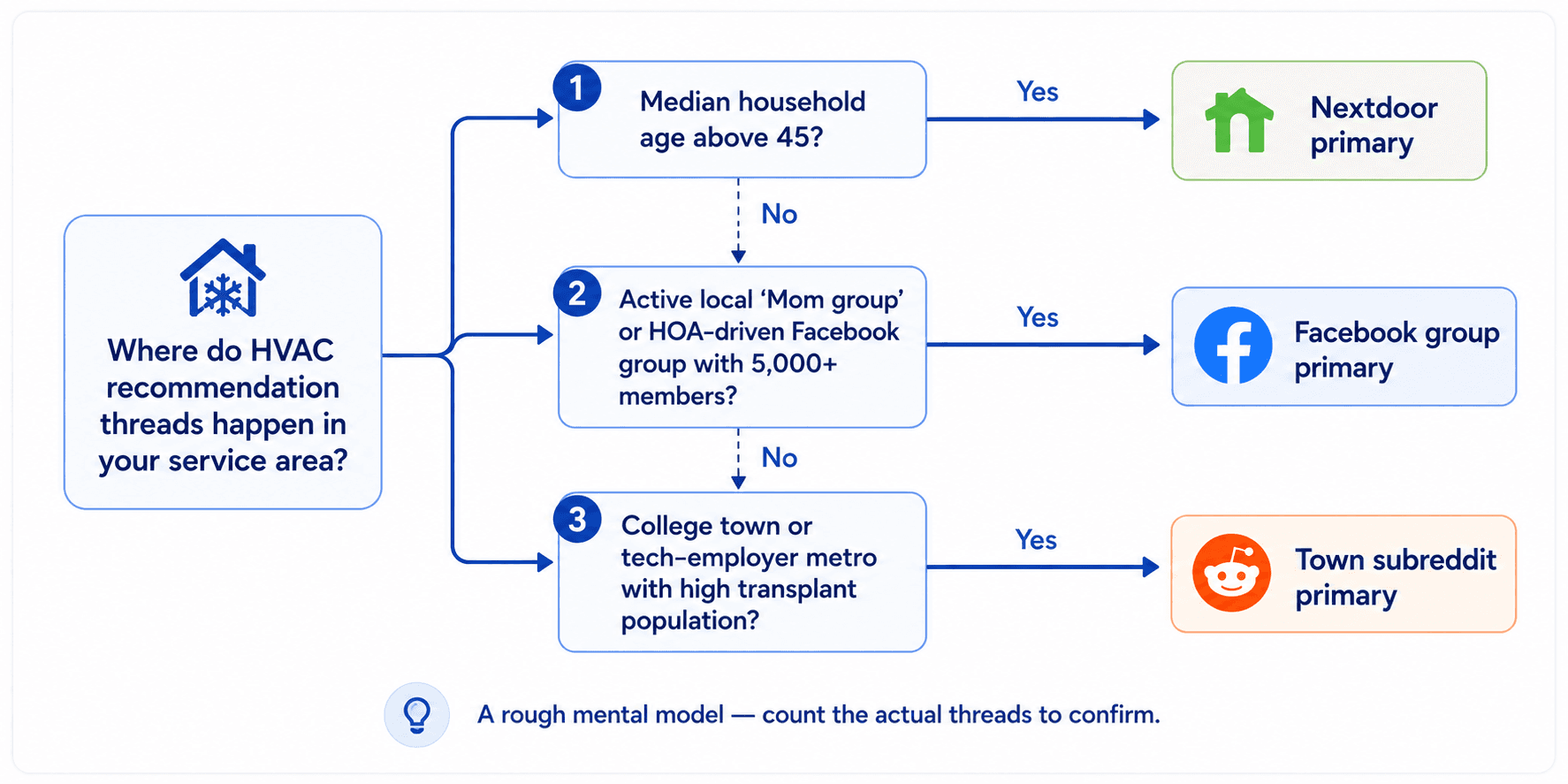
How to figure out which surface is primary in your market
The rigorous answer is to count. For one of your top neighborhoods, manually catalog the HVAC-recommendation threads that happened on each surface in the last 90 days, and weight them by how many neighbors saw and engaged with each.
The faster answer is to ask a question of three or four recent customers: "If you needed to ask your neighbors for an HVAC recommendation tomorrow, where would you post?" Most customers will answer instantly and without thinking. The pattern across their answers — even just three or four data points — usually tells you which surface is primary, because the answer reflects where they already see those conversations happening.
A few useful tells:
- If your customers say "I'd just ask in the [Town] Facebook group" without hesitation, the Facebook group is dominant.
- If they say "I'd post on Nextdoor" (especially with an exasperated note about it), Nextdoor is dominant.
- If they say "I'd just Google it" or "I'd ask in the subreddit," you're probably in a younger-transplant-heavy market and the dominant surface is fragmented across Reddit and Google.
- If they say "I'd text my neighbor Linda," your local recommendation traffic is happening offline and the operator question shifts to how often does Linda recommend you.
The wrong move is to focus equally on all three surfaces. In any given metro, one of them is doing roughly 2–5× the work of the others. Putting your operational attention into the dominant surface — the one your customers are actually using — produces meaningfully better results than splitting effort evenly.
The synthesis
The recommendation-surface dynamics described in the welcome post, the first-hour post, and the cross-thread post apply identically across all three platforms. The mechanics of how thread mentions compound don't change based on whether the thread is on Nextdoor, Facebook, or Reddit.
What does change is where the threads happen, and therefore where your past customers need to be present and willing to mention you. Knowing which surface is primary in your market means you can concentrate the operational work (recall engineering, density clustering, advocate-customer cultivation) on the platform where it actually compounds, rather than spreading thin across three.
If you want to see where the HVAC-recommendation threads in your specific service area are actually happening — broken down by surface, with volumes and mention rates — request your free neighborhood report. The split is usually starker than operators expect.
The lever is the same on all three surfaces. The volume isn't.