The Difference Between a Happy HVAC Customer and One Who'll Type Your Name in a Thread
Five-star reviews and unprompted thread recommendations are different acts with different requirements. Here's the gap, and what bridges it.
Sarah likes you. Her AC went out in August, you got a tech to her house the same afternoon, the price was fair, the system has run quiet ever since. She left a five-star Google review the next week without being asked.
Six months later, her neighbor posts in the local Facebook group: "Our furnace is making a weird grinding noise — anyone have an HVAC company they trust?"
Sarah reads the post. She scrolls past without commenting.
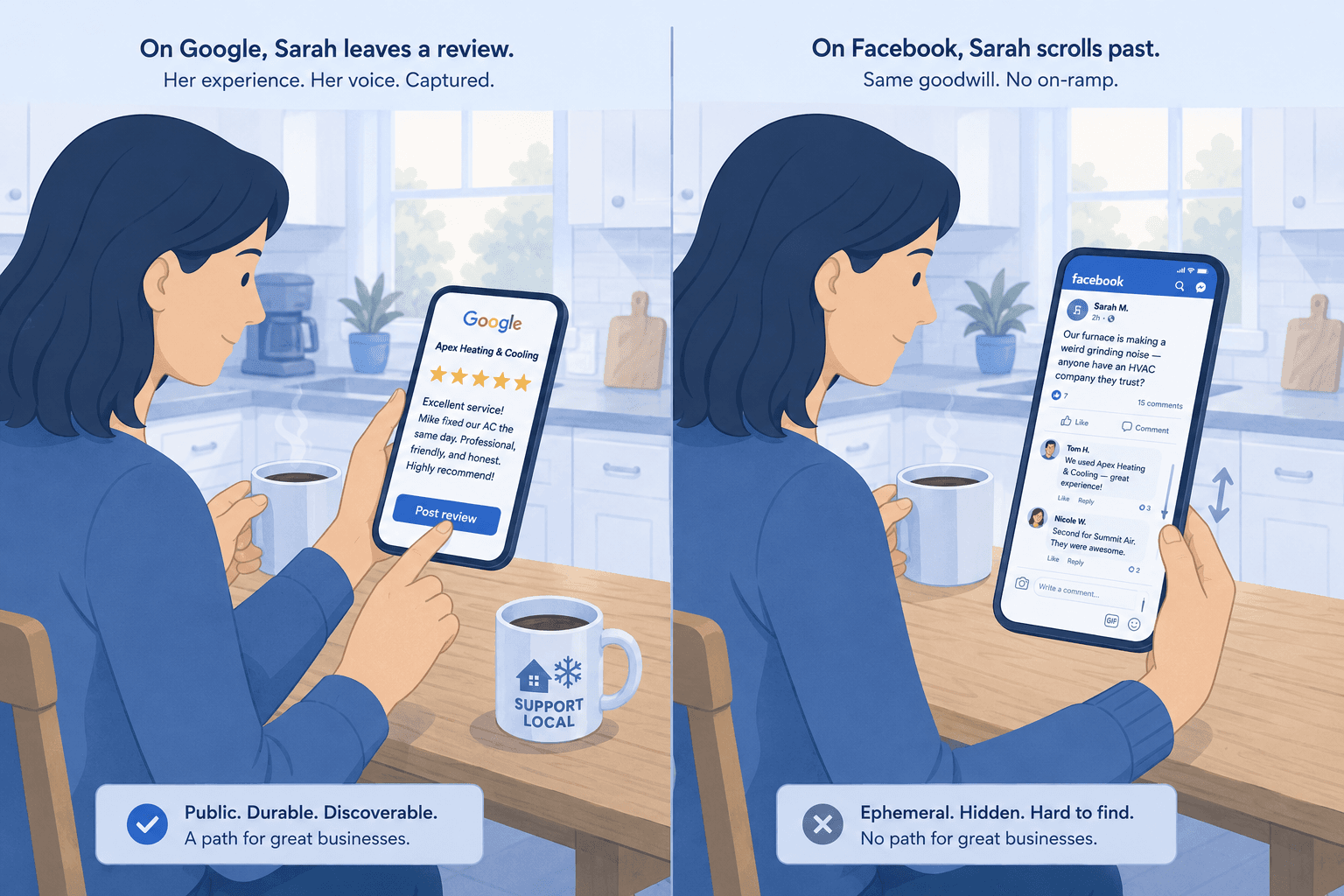
This is the most common failure mode in the gap between "happy customer" and "thread mention." Sarah's goodwill is real. Her review is real. But the act of typing your name into a neighborhood thread is a different act from leaving a review, with different requirements — and most HVAC operators conflate the two.
A review is private-ish. A thread mention is reputational risk.
When Sarah leaves a Google review, the audience is strangers. If she's wrong about you — if the next homeowner has a bad experience — there's no social cost to Sarah. She doesn't know the next homeowner. The review sits in a database somewhere; her name is attached, but only at a low resolution.
When Sarah types your name in the local Facebook group, the audience is her actual neighbors. People she'll see at the PTA meeting, at school dropoff, at the block party. If she vouches for you and the next homeowner has a bad experience, she hears about it. Possibly in person. Possibly more than once.
This isn't an exotic dynamic — it's exactly the same reason people are more careful about who they recommend to a close friend than who they recommend on Yelp. The audience proximity changes the calculation.
The practical effect: every public recommendation has a higher trust threshold than the equivalent private review. A four-star Google reviewer might be a comfortable thread mentioner. A five-star Google reviewer might not be. The signal that crosses the threshold isn't whether the work was good — it was good in both cases — it's whether Sarah is confident the next person will get the same experience.
What clears the threshold
Three things, in roughly this order of importance:
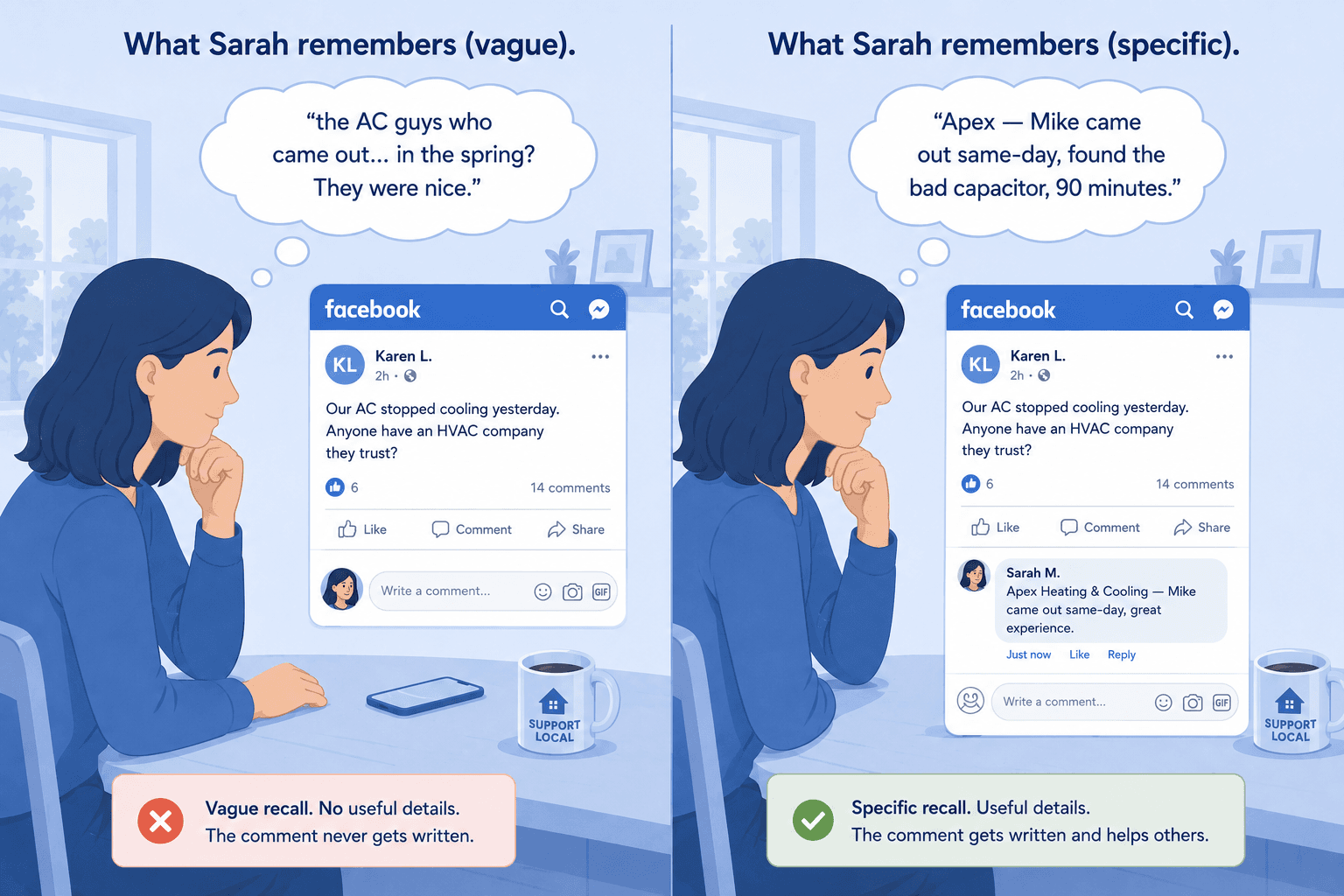
A specific story she can lean on. "Mike came out the same afternoon, found the bad capacitor, was out in 90 minutes" is the kind of recall that makes a recommendation feel safe. "They were really professional" is too generic to defend if the neighbor has a different experience. Specificity is how Sarah signals to her audience that she has a real, recent reference point, not a vague impression. The story is the evidence she can point at if challenged.
Your actual business name, not your category. "The AC guys we used" doesn't end up in a thread — the friction to look up and type the company name is too high. "Apex Heating & Cooling" does. If the customer remembers you as "the company that fixed the AC," you're already out of the running for the mention even if she'd vouch for you in person. The name has to surface in her head in under ten seconds, or the comment doesn't happen.
A recent reference point. Recommendation acts are confident when the memory is fresh. Two years out from the job, even a happy customer's confidence has decayed enough that she'll often defer to a neighbor who used someone more recently. This is why the operators who win threads tend to also be the operators with high job density — they're producing recent reference points across the neighborhood every season.
What this means for the operator
The temptation, reading this, is to add a step to the close-out process — a script, an ask, a follow-up text — to "make sure" the customer will recommend you. That works for clearing the review threshold. It doesn't reliably clear the thread mention threshold, because that one isn't about willingness; it's about recall and confidence.
The operators who get mentioned in threads consistently aren't the ones with the slickest ask. They're the ones whose customers leave the job remembering a specific story, a specific name, and a specific outcome — and who keep producing new such moments in the same neighborhoods so the reference points stay fresh.
That's an operational pattern, not a marketing tactic. The job has to be specific enough to remember, the technician has to be a person not a logo, and the close-out has to leave the customer with a sentence she could repeat without thinking about it.
If you want to see how often your past customers actually clear that bar in your service area — how many of them are showing up in the threads where neighbors are asking the question — request your free neighborhood report. It's a snapshot of what's making it into the conversation and what isn't. The founding post covers why this surface matters at all; the why-same-three post covers what happens once you start clearing the bar consistently.
The gap between "happy customer" and "thread mention" is real, but it isn't a mystery. It's a recall problem and a confidence problem. Both are operator-solvable.