The Half-Life of a Neighborhood HVAC Recommendation Thread
How long does a recommendation thread actually decide jobs? The active window is short. The artifact lives much longer. The implications change what 'showing up' means.
The first-hour post argued that the active decision window of a neighborhood thread is short — about sixty minutes. That's true for the original question. But threads don't stop existing at the sixty-minute mark; they shift into a different phase, with different mechanics, and the operator who only thinks about hour one is missing roughly half of what makes this surface compound.
Here's the full lifecycle.
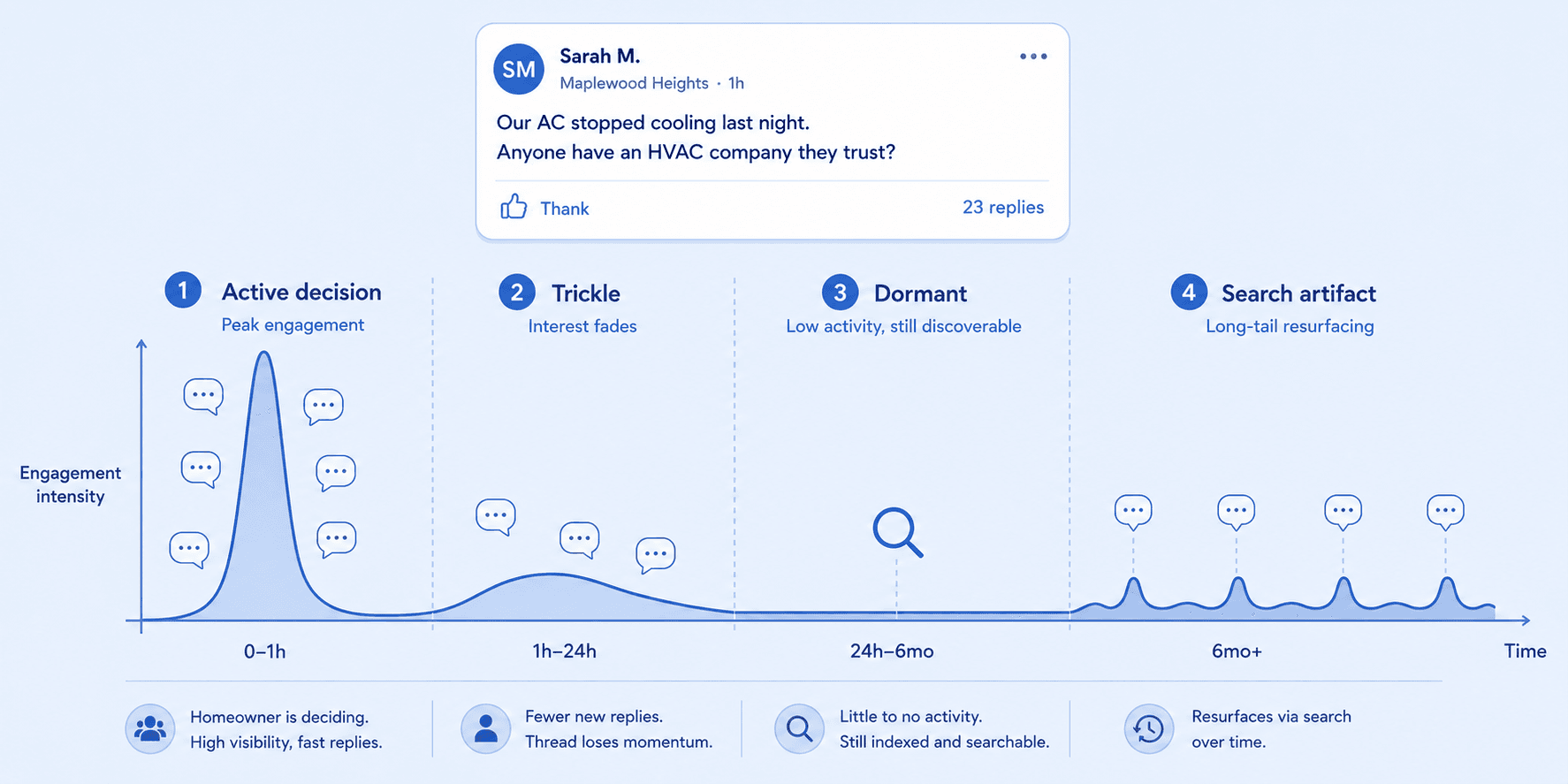
Phase 1: Active decision (0–1 hour)
The original poster is reading. Notifications pull them back to the thread. The first few names that appear anchor the rest of the conversation. By the end of this phase the OP has either picked who to call or, more often with an HVAC emergency, has already started calling.
What dies here: thread velocity. By the end of hour one, the engagement that made the post visible in everyone's feed has peaked, and the platform algorithm starts deprioritizing it.
What lives: the names already in the thread, and the social proof they've accumulated (likes, "second this," replies).
Phase 2: Trickle (1 hour – 24 hours)
A few more comments arrive — usually from neighbors who saw the post in their morning catch-up rather than in real time. These comments matter much less for the original job, which is usually decided, but they matter for the long-term reputation of the thread. A name that gets a late "I used them too" reply gains additional social proof even if the OP has already made a call.
What dies here: any chance of being the company the OP actually hires. That ship has sailed.
What lives: the thread's accumulating "vote count" for each named company, which other neighbors will scroll back through when they have their own question later.
Phase 3: Dormant (24 hours – 6 months)
The thread leaves everyone's active feed. Nobody is reading it. The OP has been served by whoever they hired. To a casual observer, the thread is dead.
It isn't. It's just below the surface, indexed, searchable, and waiting.
What dies here: visibility in the feed. Nobody finds the thread by scrolling.
What lives: search-indexability. Inside the Facebook group or Nextdoor neighborhood, the thread is now part of the searchable corpus. Anyone typing "HVAC" or "AC repair" into the group's search bar can find it.
Phase 4: Search artifact (6 months onward)
Six months later — or 18, or three years — someone new in the neighborhood posts a similar question. Anyone have an HVAC company they recommend?
A handful of things happen at the same time:
- Some of the most engaged neighbors don't just answer from memory; they scroll the group's history, find the old thread, and re-surface the same names that won it. ("Look, here's a thread from two summers ago — these three companies kept coming up.")
- The new OP, before posting or after, often searches the group themselves to see if it's been asked recently. They find the old thread. The names with the most "second this" votes get carried forward.
- The original commenters, if they're still active in the group, often re-comment with the same recommendations. They remember who they vouched for last time.
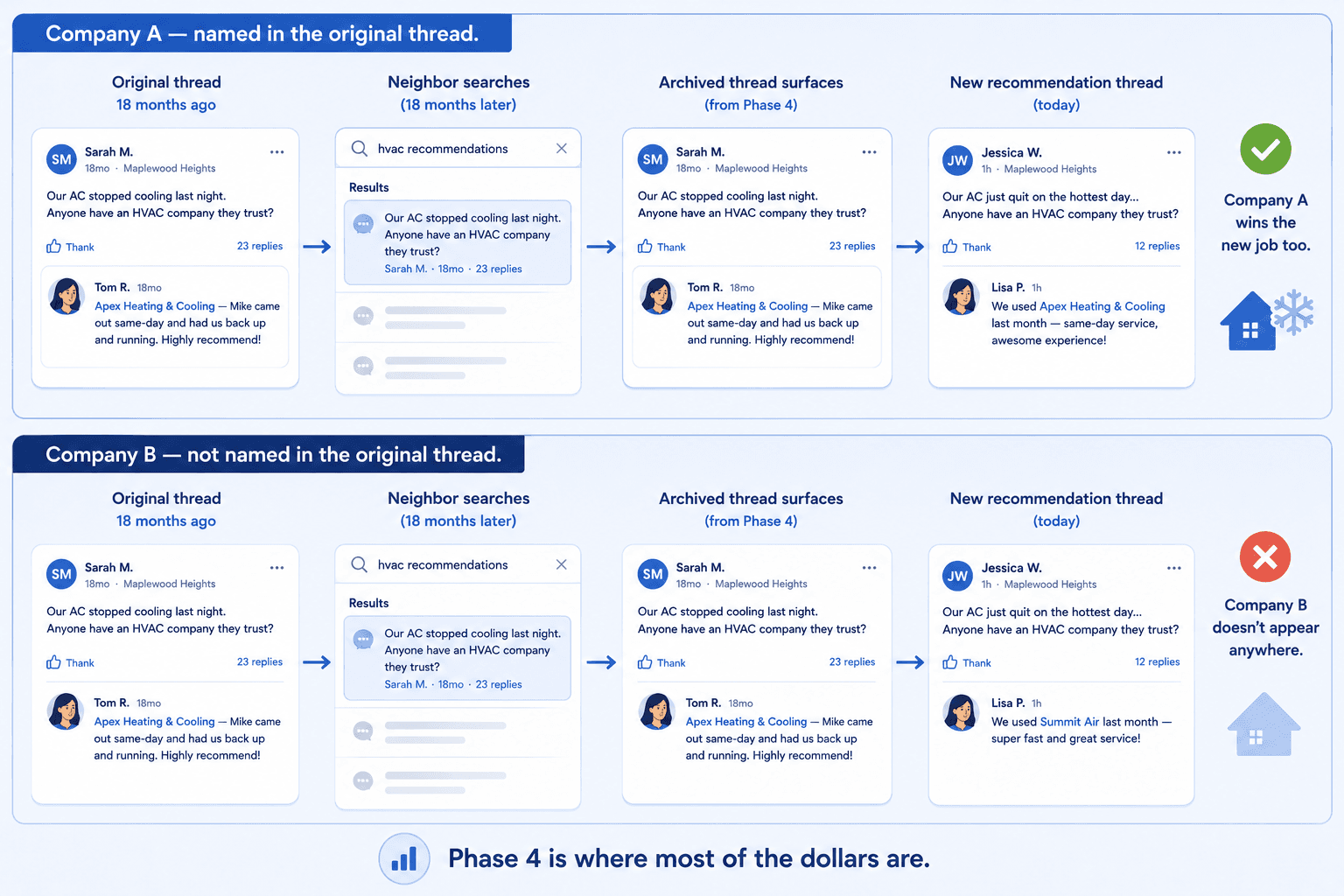
What lives here: the thread itself becomes the recommendation, not just a moment of it. The HVAC company named in the original thread is still winning jobs from it years later, by surfacing every time a neighbor with the same question searches the group.
What dies here: the chance for an HVAC company that wasn't in the original thread to be retroactively added. Nobody goes back to a two-year-old thread to add a new name. The roster is locked.
What this means operationally
The implications are uncomfortable for a few reasons.
The "first hour" pressure is real, but it's not the only pressure. A thread you're absent from in hour one is also a thread you're absent from for the next several years. Every time it re-surfaces as a search result, you're missing again. That's not one lost job. That's a compounding loss.
The work in hour one pays off for years. Conversely, the company that gets named in the first hour isn't just winning the one call. They're getting added to a permanent reference that re-emerges every time the question gets asked again. The cost-per-mention math, properly computed, has to amortize across that lifecycle.
Monitoring is a short-window strategy applied to a long-window problem. Even if you had a perfect Facebook/Nextdoor monitoring system that pinged you the second any neighborhood thread mentioned HVAC, you'd still only be able to act in the active phase. The Phase 4 dynamics — where most of the compounding lives — aren't reachable via monitoring at all. You can't comment your way into a two-year-old thread that's already been searched and re-surfaced.
The lever that does work across all four phases is the same lever the why-same-three post named: getting your business name into the original thread, in the first hour, by way of a real past customer. That mention then lives through every subsequent phase, including Phase 4, where most of the actual job volume comes from.
If you want to see how many of your service area's threads you're showing up in across all four phases — not just the live ones — request your free neighborhood report. The dormant and search-artifact phases are harder to see than the active ones, but they're where most of the dollars are decided.
The first hour decides the job. The next four years decide the franchise.